Exercise After a Heart Attack: A Safe Return to Activity
Learn how to safely resume physical activity after a heart attack. Guidelines for cardiac rehabilitation exercise and building back your strength.
[AddInfographic]
Exercise After a Heart Attack: A Safe Return to Activity
We know the pressure to get back to managing your business or home is real. Following a heart attack, most people feel a mix of urgency to return to their responsibilities and fear that any exertion might cause more damage. This hesitation is natural, but the data tells a different story.
From what we see in practice, inactivity is actually the bigger risk. A sedentary recovery can lead to deconditioning that makes even simple tasks like checking on a job site or maintaining your property feel exhausting.
We want to help you rebuild your strength safely so you can confidently handle your daily demands again. Let’s look at the recovery timeline, the specific metrics you need to watch, and a practical plan for getting back to work and life.
Why Exercise Matters After a Heart Attack
You might assume that strict bed rest is the safest path, but modern cardiology supports active recovery. We have found that controlled movement is often the most powerful tool for healing damaged heart muscle.
A 2025 study highlights that for secondary prevention, every increase of 500 MET-minutes (a measure of energy expenditure) per week can reduce mortality risk by approximately 14%. This suggests that getting moving isn’t just about feeling better; it is a critical factor in long-term survival.
Consistent, appropriate exercise delivers these specific benefits:
- Improves efficiency: Your heart pumps more blood with less effort.
- Reduces readmission risk: Active patients are less likely to end up back in the hospital.
- Lowers mortality: Long-term survival rates are significantly higher for active patients.
- Controls key numbers: It helps manage blood pressure and cholesterol naturally.
- Boosts mental health: Physical activity reduces the depression that often follows a cardiac event.
- Restores functional capacity: You regain the stamina needed for work and home management.
The Role of Cardiac Rehabilitation
Cardiac rehabilitation (cardiac rehab) is the gold standard for safe recovery, yet participation rates in the US remain surprisingly low, often between 19% and 30%. We strongly encourage you not to be part of the statistic that skips this vital step.
These programs are not just “exercise classes”; they are medically supervised data-driven interventions. We see a clear difference in outcomes for patients who attend. A study of patients undergoing heart bypass surgery found that those who attended rehab had a 3-5% absolute reduction in mortality over two years compared to those who didn’t.
Cardiac Rehab vs. Independent Exercise
| Feature | Cardiac Rehab Program | Independent Exercise |
|---|---|---|
| Supervision | Medically supervised by nurses & physiologists | Self-monitored or family-monitored |
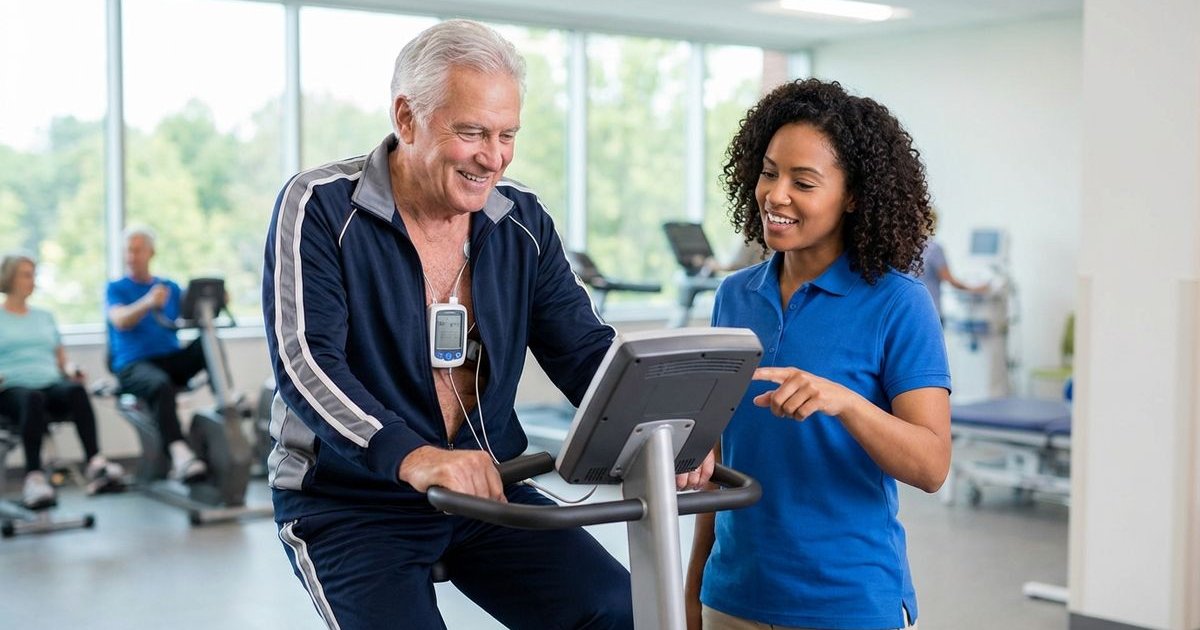
| Safety | Real-time EKG monitoring during exertion | No professional monitoring |
| Guidance | Personalized progression plans | Generic guidelines or guesswork |
| Education | Classes on nutrition, stress, and meds | Self-taught via internet or books |
| Outcome | 36+ sessions typically yield best results | Variable results depending on discipline |
We recommend starting a program immediately. Research suggests that for every day you delay enrollment, you are 1% less likely to ever start.
Phases of Exercise Recovery
Recovery is a step-by-step process, not a switch you flip. We break this down into phases to help you gauge where you stand.
Phase I: In the Hospital
Recovery starts before you even leave the building. We focus on basic mobility to prevent stiffness and blood clots.
- Sitting up in bed to eat.
- Standing and gentle walking in your room.
- Walking in the hallway with assistance.
- Climbing a few stairs under supervision.
The goal here is simply to offset the effects of lying in bed.
Phase II: Outpatient Cardiac Rehabilitation
This phase usually begins shortly after discharge and lasts about 12 weeks. We structure this time to build your confidence alongside your strength.
Weeks 1-4: The Foundation
- Activity: Light walking on a treadmill or seated stationary cycling.
- Focus: Learning to monitor your heart rate and recognizing safe exertion levels.
- Intensity: Very low. You should be able to sing a song while doing these activities.
Weeks 5-8: Building Capacity
- Activity: Increasing duration and introducing variety like elliptical machines.
- Focus: Improving endurance so you can handle longer days at work or home.
- Intensity: Moderate. You should be able to talk but not sing.
Weeks 9-12: Progression to Independence
- Activity: Approaching normal exercise levels and adding light resistance.
- Focus: Preparing a long-term plan that fits your lifestyle.
- Intensity: Moderate to somewhat hard, guided by your team.
Phase III: Maintenance
This is where the training wheels come off. We help you transition to a community gym or a home routine that fits your schedule.
How to Exercise Safely
Safety is about understanding your limits and using the right tools. We advise using both subjective feelings and objective data to keep yourself in the safe zone.
Monitor Your Intensity
You need to know exactly how hard your heart is working. We recommend three reliable methods to gauge this.
1. The Talk Test This is the simplest and most practical tool. You should always be able to carry on a conversation while exercising. If you are gasping for air or cannot finish a sentence, you are working too hard and need to slow down immediately.
2. Rate of Perceived Exertion (RPE) We use a scale from 6 to 20 to rate how hard you feel you are working.
- 11-12 (Fairly Light): Ideal for warm-ups and cool-downs.
- 12-14 (Somewhat Hard): The target zone for your main workout.
- 15+ (Hard): Generally too intense for early recovery unless cleared by your doctor.
3. Heart Rate Monitoring Your rehab team will give you a specific target heart rate zone. We often suggest reliable chest strap monitors like the Polar H10 or Garmin HRM-Pro for the most accuracy during recovery. Wrist-based devices like the Apple Watch Series 10 or Garmin Vivomove Sport are also useful for tracking trends and spotting irregularities like AFib.
Warning Signs to Stop Exercise
Listen to your body’s distress signals. We instruct patients to stop immediately if they notice:
- Chest pain, pressure, or “heaviness.”
- Unusual shortness of breath (disproportionate to the effort).
- Dizziness, lightheadedness, or seeing spots.
- Irregular heartbeats or palpitations.
- Cold sweats or nausea.
- Pain spreading to the arms, back, neck, or jaw.
If resting does not relieve these symptoms, call your doctor. If they are severe or feel like your heart attack symptoms, call 911.
General Guidelines
- Warm up: Spend 5-10 minutes easing into movement to open up your blood vessels.
- Cool down: Never stop abruptly; walk slowly for 5 minutes to let your heart rate settle.
- Hydrate: Drink water before and during your session.
- Check the weather: Extreme cold (below freezing) can cause vasoconstriction, raising blood pressure. We suggest wearing a scarf over your mouth to warm the air or exercising indoors if it is below 32°F.
- Progress slowly: Follow the “10% Rule” by increasing your time or intensity by no more than 10% each week.
Types of Appropriate Exercise
We categorize activities by their metabolic cost, or METs, to help you choose what is safe.
Aerobic Exercise (The Foundation)
These activities strengthen your heart muscle and improve oxygen efficiency.
- Walking: The most accessible option (2-4 METs).
- Stationary Cycling: Great for controlling intensity (3-5 METs).
- Water Aerobics: Excellent for joints, but wait until incisions are fully healed.
- Elliptical Training: Offers a full-body workout without impact.
Goal: Aim for 30-60 minutes on most days to reach a total of 150 minutes per week.
Resistance Training
Strong muscles take the load off your heart. We generally clear patients for light lifting 4-6 weeks after their event.
- Start light: Use resistance bands or 2-5 lb weights.
- Technique first: Focus on smooth, controlled movements.
- Important Safety Tip: Never hold your breath while lifting. This is called the Valsalva maneuver and it can cause dangerous spikes in blood pressure. Exhale as you lift the weight.
Home & Business Maintenance (Functional Fitness)
We know you have tasks to get back to. Here is how common chores rate in intensity:
- Light (1-3 METs): Desk work, driving, light assembly, washing dishes while standing.
- Moderate (3-6 METs): Raking leaves, power mowing the lawn, painting, general gardening.
- Vigorous (6+ METs): Shoveling snow, moving heavy furniture, carrying loads over 50 lbs. Avoid these until fully cleared.
Specific Warning: Shoveling snow is particularly risky because it combines high exertion with cold air and isometric straining. We strongly advise hiring this task out for your first winter post-recovery.
Common Questions
When can I return to work?
This depends entirely on the physical demands of your role.
- Sedentary/Desk Jobs: Often 2-4 weeks for a minor event; 4-6 weeks after bypass surgery.
- Physical Labor: Typically 8-12 weeks, possibly with permanent modifications.
- Business Owners: We recommend delegating physical tasks early on and returning to administrative duties first.
When can I drive?
Most patients are cleared 1-2 weeks after discharge if they are stable and off strong pain medication. We advise checking with your specific state regulations as they can vary.
When can I resume sexual activity?
Sexual activity is a form of moderate exercise (about 2-3 METs). We typically say it is safe to resume once you can comfortably climb two flights of stairs without chest pain or gasping for breath.
Will I ever exercise normally again?
Many of our patients eventually return to their previous fitness levels or even exceed them. Your long-term capacity depends on the extent of the damage, but consistent rehab is the best way to maximize your potential.
Building Long-Term Habits
Motivation often fades after the initial scare wears off. We suggest these strategies to keep you on track:
- Convenience is key: Remove friction by choosing activities you can do from home or work.
- Track your data: Use a wearable or logbook to see your progress over months.
- Find a partner: You are less likely to skip a walk if someone is waiting for you.
- Schedule it: Treat your workout like a client meeting that cannot be moved.
- Plan for weather: Have an indoor backup plan like a mall walk or home bike for bad days.
Get Started with Expert Guidance
Recovering from a heart attack is a major project, but you do not have to manage it alone. We specialize in helping people navigate the path from “patient” back to “active individual.”
At Los Angeles Heart Specialists, our cardiac rehabilitation program is designed to give you the structure and safety you need. We monitor your progress with clinical precision so you can focus on getting back to the life you love.
Contact us to learn more about our cardiac rehabilitation services and start your recovery journey.

LA Heart Specialists Team
Our team of board-certified cardiologists and medical writers provide expert insights on heart health.
Learn more about our teamRelated Articles

Heart-Healthy Diet: Top Tips from Cardiologists
Discover cardiologist-recommended dietary changes to protect your heart. Learn which foods to embrace and which to limit for optimal cardiovascular health.

How Stress Affects Your Heart and What to Do About It
Understand the connection between chronic stress and heart disease. Learn practical stress management techniques to protect your cardiovascular health.
Have Questions About Your Heart Health?
Our board-certified cardiologists are here to help. Schedule a free consultation to discuss your concerns.